A

a

a

A

A

A

✅ 1. The 12 Lung Areas
Each hemithorax = 6 zones
Total = 12 zones
Anterior (2 per side)
-
Upper anterior
-
Lower anterior
Lateral (2 per side)
-
Upper lateral
-
Lower lateral
Posterior (2 per side)
(If safe to turn the infant)
-
Upper posterior
-
Lower posterior
→ Right lung: 6 zones
→ Left lung: 6 zones
🟩 2. LUS SCORE PER ZONE (0–3)
Score 0 — Normal aeration
-
A-lines present
-
Normal lung sliding
-
≤2 isolated B-lines
Score 1 — Moderate loss of aeration
-
2 B-lines (non-confluent)
-
Pleura may appear mildly irregular
Score 2 — Severe loss of aeration
-
Coalescent B-lines (white lung appearance)
-
No regions of normal aeration in that zone
Score 3 — Consolidation
-
Subpleural consolidation
-
Tissue-like echotexture
-
May have air bronchograms
🟥 3. TOTAL LUS SCORE FOR RDS SEVERITY
Add up all 12 zones:
| Total Score | Interpretation |
|---|---|
| 0–5 | Mild / normal aeration |
| 6–12 | Moderate aeration loss |
| 13–18 | Moderate–severe aeration loss |
| 19–36 | Severe RDS (white lung + consolidations) |
(Ranges vary slightly in publications, but these are widely used clinical thresholds.)
📌 4. How It’s Used Clinically
-
Diagnose RDS vs TTN
-
TTN = more B-lines, less consolidation
-
RDS = coalescent B-lines + posterior worsening + consolidations
-
-
Guide surfactant therapy
-
LUS Score ≥ 10–12 → often correlates with need for surfactant
-
-
Track lung improvement after CPAP, HFNC, ventilation
-
Reduce X-rays in NICU
🟦 5. Quick Summary (1 Glance)
12 zones: A2 + L2 + P2 (each side = 6)
Score 0–3 per zone → total 0–36
Higher score = worse aeration
Consolidation = 3 (worst)
A
Here’s a clear, clinical explanation of the Snowflake Sign in neonatal lung ultrasound — concise and accurate.
❄️ SNOWFLAKE SIGN – Neonatal Lung Ultrasound


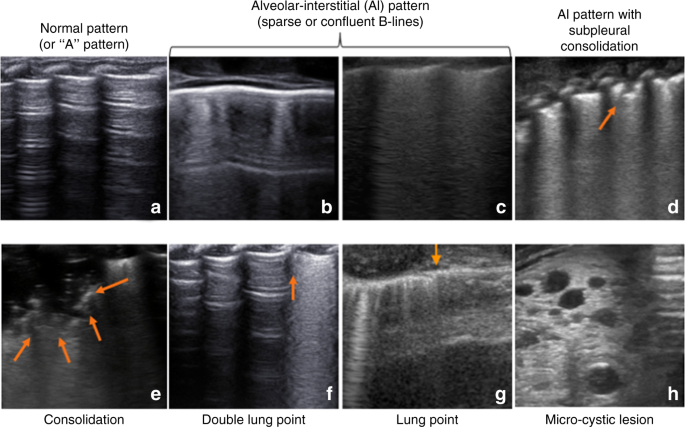
✅ What It Is
The Snowflake Sign refers to hyperechoic (bright), punctate or branching “snowflake-like” air bronchograms seen within a large subpleural consolidation on lung ultrasound.
It looks like tiny white specks or flakes inside a tissue-like lung region.
✅ What It Indicates
Typical of SEVERE RDS (Hyaline Membrane Disease), due to:
-
Marked loss of lung aeration
-
Surfactant deficiency
-
Micro-atelectasis
-
Collapse with trapped air in bronchi → “snowflakes”
It is a highly specific sign of RDS, not TTN.
🧠 Why It Happens
In severe RDS:
-
Alveoli collapse → tissue-like consolidation
-
Some air remains in bronchi → appears as bright, scattered points
-
These points shimmer/cluster → the “snowflake” appearance
🩺 Diagnostic Meaning
| Sign | Interpretation |
|---|---|
| Snowflake sign | Severe RDS (surfactant deficiency) |
| Location | Usually anterior + posterior lung zones |
| Associated score | LUS score in these zones = 3 (consolidation) |
| Clinical implication | Often correlates with surfactant requirement |
🔍 Differentiation from Other Signs
Not TTN → TTN shows B-lines but NO tissue-like consolidation.
Not pneumonia → pneumonia shows irregular, localized consolidations with dynamic air bronchograms, not snowflakes.
Snowflake sign = diffuse, homogeneous consolidation with hyperechoic micro-bronchograms.
📌 Ultra-Short Definition
“Snowflake sign = bright micro-air-bronchograms scattered within a homogeneous consolidation → hallmark of severe neonatal RDS.”
A

A
SNOW FLAKE ON 3-4

A

A

A
GOLDEN HOUR- DEXTROSE, CAFFEINE, LINES

A

A
UN STEROIDED BOY - MORE AT RISK - MAY NEED 2ND DOSE AFTER 12 HRS
cf STEROIDED GIRL
A
INSUREC
INSUREc is a common neonatal respiratory management acronym.
✅ INSUREc = INtubate – SURfactant – Extubate (to CPAP)
Here’s the breakdown:
-
IN – Intubate the infant
-
SU – Give Surfactant through the endotracheal tube
-
RE – Extubate immediately
-
C – to CPAP (Continuous Positive Airway Pressure)
📌 What It Means Clinically
INSUREc is used for babies with RDS to:
-
give surfactant early
-
avoid mechanical ventilation
-
reduce lung injury (BPD risk)
-
return quickly to non-invasive support (CPAP)
📌 Ultra-Short Definition
INSUREc = Surfactant via brief intubation → immediate extubation → CPAP support.
If you want, I can also explain:
-
When to use INSURE vs LISA/MIST
-
Criteria for CPAP failure
-
Surfactant dose triggers using LUS score
Just tell me!

A
NOT AS SENS SPF AFTER 34 WKR
LUNG US FOR RDS BEST BETN 24-24 WKRS

A

No comments:
Post a Comment