ETS BDHA - ENJOY THE SUFFRING - DULL FOOD-ALT SIPS OF WATER
Explore the seven ways of being—steadiness, lovingness, fullness, wholeness, nowness, allness, and timelessness—and try to get a clear sense of each one. Imagine or feel that they are already natural for you, already part of who you are.
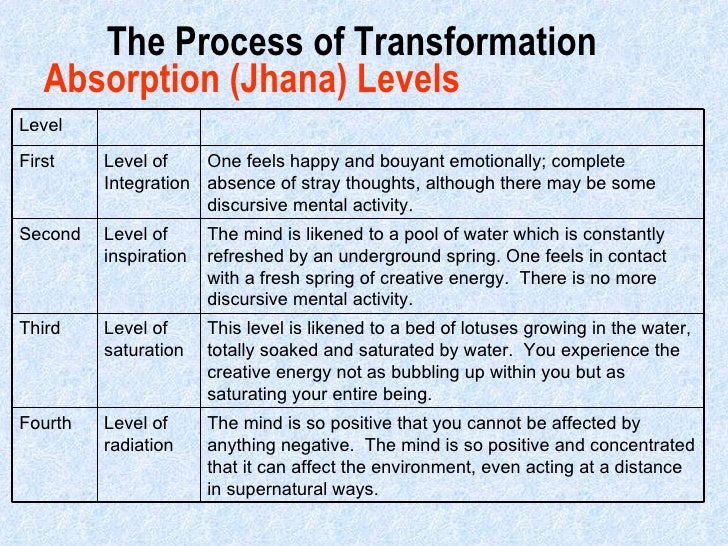
/////////////4 JHANAS
Buddha said was wise concentration, which consists of four nonordinary experiences called the jhanas: Quite secluded from sensual desires, secluded from unwholesome states of mind, a person enters and abides in the first jhana, which is accompanied by applied and sustained attention, with bliss and happiness born of seclusion. With the stilling of applied and sustained attention, the person enters and abides in the second jhana, which has inner clarity and one-pointedness of mind without applied and sustained attention, with bliss and happiness born of concentration. With the fading away of bliss, the person abides in equanimity, and mindful and fully aware, still feeling happiness in the body, enters and abides in the third jhana, on account of which noble ones announce: “A person has a pleasant abiding who has equanimity and is mindful.” With the abandoning of pleasure and pain, and with the previous passing away of elation and distress, the person enters and abides in the fourth jhana, which has neither pain nor pleasure and purity of mindfulness due to equanimity.
/////////////////
/////////////////Taken literally—“All conditioned things are suffering”—this statement cannot be true. All conditioned things can’t be suffering. Suffering is an experience. A chair is a conditioned thing—a physical object—that cannot have an experience, and it cannot be an experience. So it would be wrong to say, “All chairs are suffering.” A related version of this that I’ve heard is “Life is suffering.” Yet, is it? Experiences—at least as this word is normally used—require a nervous system. Plants and microbes do not have nervous systems. Therefore, they can’t have experiences, so they can’t suffer. Bones and blood and neurons don’t suffer, either. This is not just semantics: suffering is not “out there” in physical objects or in life as a whole. Most conditioned things are not suffering. It can feel startling and freeing to recognize that suffering is just a small part of everything.
////////////////////HOLDING ONTO MISSED ICE CREAM
I know what it’s like to want some ice cream but then find that the container is empty; to have a strong opinion that no one should ever take the last bit of ice cream without seeing if I want some, too; to want a new rule about this in my home; and to feel annoyed that someone took “my” ice cream. This kind of holding is a form of craving, and you can observe it with mindfulness. Like everything else in awareness, craving increases and decreases, ebbs and flows. With practice, you can get more comfortable with letting go instead of holding on, which is a theme throughout this book. Also, as we’ll see in the second half of this chapter, you can feel already full, already at ease, and therefore less driven to hold on to any moment at all. Even at its most intense, the first kind of holding is only a part of consciousness, not the whole of it. And with practice, this type of holding gradually releases
//////////////////////////THREE CAUSES OF CRAVING Our craving comes from three sources. First, there are social factors such as insecure attachment and feelings of inadequacy, loneliness, envy, and resentment. Practices of relationship for these factors include compassion, kindness, and happiness for others. Second, there are visceral factors based on a sense of needs unmet: something is missing, something is wrong. In Pali, the language of early Buddhism, the word for craving is tanha, whose root meaning is “thirst”— which is particularly apt for the drives that underlie these sources of craving. You can address them through practices of fullness that develop both specific inner strengths for meeting your needs and general feelings of enoughness and emotional balance. ...............DTR CRSS X BNCABOD LINE
Third, there are cognitive factors, due to thinking that: • something is lasting when actually it is changing; • something will be continually satisfying when actually nothing can be continually satisfying; or • there is a fixed “I” or “me” inside when actually there is no fixed self inside.
////////////////////////
Explore the seven ways of being—steadiness, lovingness, fullness, wholeness, nowness, allness, and timelessness—and try to get a clear sense of each one. Imagine or feel that they are already natural for you, already part of who you are.
/////////////4 JHANAS
Buddha said was wise concentration, which consists of four nonordinary experiences called the jhanas: Quite secluded from sensual desires, secluded from unwholesome states of mind, a person enters and abides in the first jhana, which is accompanied by applied and sustained attention, with bliss and happiness born of seclusion. With the stilling of applied and sustained attention, the person enters and abides in the second jhana, which has inner clarity and one-pointedness of mind without applied and sustained attention, with bliss and happiness born of concentration. With the fading away of bliss, the person abides in equanimity, and mindful and fully aware, still feeling happiness in the body, enters and abides in the third jhana, on account of which noble ones announce: “A person has a pleasant abiding who has equanimity and is mindful.” With the abandoning of pleasure and pain, and with the previous passing away of elation and distress, the person enters and abides in the fourth jhana, which has neither pain nor pleasure and purity of mindfulness due to equanimity.
/////////////////
/////////////////Taken literally—“All conditioned things are suffering”—this statement cannot be true. All conditioned things can’t be suffering. Suffering is an experience. A chair is a conditioned thing—a physical object—that cannot have an experience, and it cannot be an experience. So it would be wrong to say, “All chairs are suffering.” A related version of this that I’ve heard is “Life is suffering.” Yet, is it? Experiences—at least as this word is normally used—require a nervous system. Plants and microbes do not have nervous systems. Therefore, they can’t have experiences, so they can’t suffer. Bones and blood and neurons don’t suffer, either. This is not just semantics: suffering is not “out there” in physical objects or in life as a whole. Most conditioned things are not suffering. It can feel startling and freeing to recognize that suffering is just a small part of everything.
////////////////////HOLDING ONTO MISSED ICE CREAM
I know what it’s like to want some ice cream but then find that the container is empty; to have a strong opinion that no one should ever take the last bit of ice cream without seeing if I want some, too; to want a new rule about this in my home; and to feel annoyed that someone took “my” ice cream. This kind of holding is a form of craving, and you can observe it with mindfulness. Like everything else in awareness, craving increases and decreases, ebbs and flows. With practice, you can get more comfortable with letting go instead of holding on, which is a theme throughout this book. Also, as we’ll see in the second half of this chapter, you can feel already full, already at ease, and therefore less driven to hold on to any moment at all. Even at its most intense, the first kind of holding is only a part of consciousness, not the whole of it. And with practice, this type of holding gradually releases
//////////////////////////THREE CAUSES OF CRAVING Our craving comes from three sources. First, there are social factors such as insecure attachment and feelings of inadequacy, loneliness, envy, and resentment. Practices of relationship for these factors include compassion, kindness, and happiness for others. Second, there are visceral factors based on a sense of needs unmet: something is missing, something is wrong. In Pali, the language of early Buddhism, the word for craving is tanha, whose root meaning is “thirst”— which is particularly apt for the drives that underlie these sources of craving. You can address them through practices of fullness that develop both specific inner strengths for meeting your needs and general feelings of enoughness and emotional balance. ...............DTR CRSS X BNCABOD LINE
Third, there are cognitive factors, due to thinking that: • something is lasting when actually it is changing; • something will be continually satisfying when actually nothing can be continually satisfying; or • there is a fixed “I” or “me” inside when actually there is no fixed self inside.
////////////////////////

No comments:
Post a Comment